
Main points
1
The West faces a growing civilizational crisis marked by weakening institutions, judicial activism, and the erosion of constitutional order under concepts such as “militant democracy.”
2
Societies in crisis risk drifting toward two extremes: the dictatorship of the majority or the dictatorship of ideological minorities, both detached from a deeper moral order.
3
Law cannot function as a mere set of rules; it requires widely accepted moral and cultural foundations to maintain legitimacy, social trust, and stability.
4
When shared moral values collapse, ideology and coercion replace principle, leading to social fragmentation and the weakening of democratic order.
5
Faith and the Christian moral tradition provide the enduring foundations for human dignity, justice, and the rule of law, safeguarding both liberty and the common good.

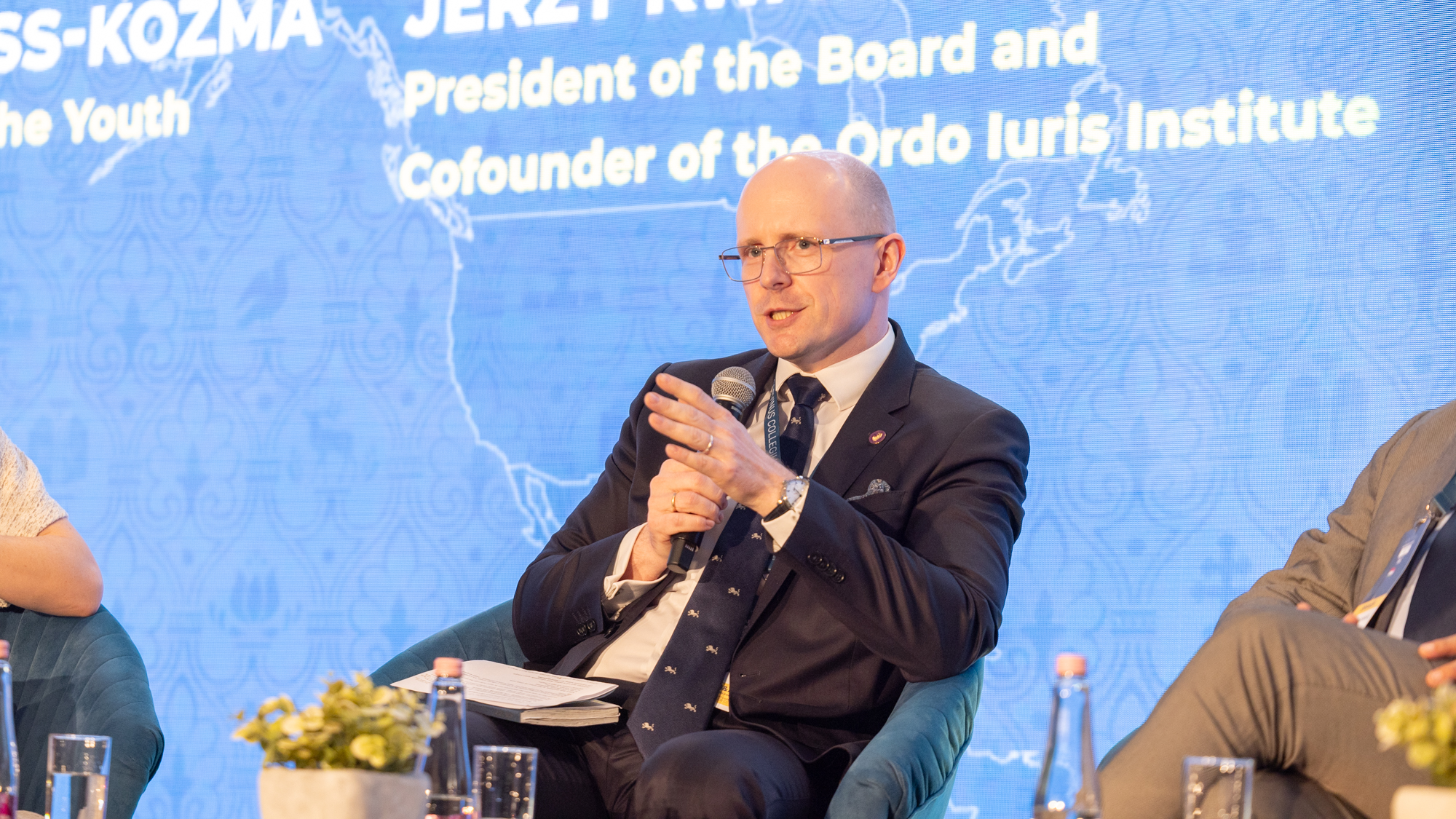
The Hungarian Mathias Corvinus Collegium is organizing an international summit in Budapest. The event is being held under the slogan “Reclaim the West.” One of the speakers at the summit was attorney Jerzy Kwaśniewski, president of Ordo Iuris. The summit is taking place from March 9 to March 11 and is devoted to exploring the possibilities of rebuilding the power of the West.
“Can the West reverse this trajectory and reclaim its role as a leading civilization? The MCC Budapest Summit on Reclaiming the West confronts this question. Addressing the core demographic, economic, cultural, and security challenges of our time, the conference seeks not merely to diagnose decline but to offer concrete strategies for renewal, confidence, and long-term civilizational endurance.
Bringing together leading statesmen, scholars, policymakers, and intellectual leaders, the summit focuses on practical paths toward stability and prosperity rather than managed decline. It emphasizes sovereignty and nation-based solutions as essential foundations for European and Western revival and explores how Europe can confront both external threats and destructive ideological currents in order to secure a viable inheritance for future generations.”
One of the speakers at the event was Ordo Iuris president Jerzy Kwaśniewski, who spoke on the subject of “Reclaiming Our Civilization: Faith and Family as the Foundations of the West’s Future.”
We publish his speech below.
Faith as the Foundation of Law and Civilization
Jerzy Kwaśniewski
We live in a time of an unrecognized state of emergency.
The crisis is already visible on the surface. Institutions are failing. Constitutional arrangements are being questioned and openly waived as so-called “militant democracy” is implemented to thwart the rise of political opponents. Judicial activism transforms our courts and tribunal into unelected supreme chambers of power.
There is a growing expectation that decisive action will restore trust, effectiveness, and order to our laws and our societies.
In moments of civilizational crisis, societies often drift toward two dangerous extremes: the dictatorship of the majority, or the dictatorship of the minority. One claims legitimacy through numbers, violating the unalienable rights of individuals. The other claims legitimacy through ideology, violently limiting the rightful political authority of the majority. Yet both share the same fundamental defect: they detach power from the deeper moral order that must guide it.
As lawyers, we understand something essential: law is not simply a collection of rules. It is a system built upon principles that are deeply rooted and—through cultural tradition—widely accepted by society.
Without such foundations, no legal system can remain stable. No law will be effectively implemented. No justice will truly be delivered. And social cohesion will begin to dissolve. Instead, democracy itself will be undone. Power will gradually replace principles. Law will become nothing more than a tool of domination.
Once a universal set of values is broken, man-made ideologies rush to fill the void.
And when a shared moral consensus—widely recognized as binding—disappears, societies begin to rely increasingly on coercion, often hidden behind fashionable language and contemporary theories.
The weaker the moral foundations of law, the greater the force required to maintain order. History has shown this pattern many times. We may be approaching such a moment today. Beyond a certain point, institutions begin to lose legitimacy and social trust collapses. In such conditions, people cease acting as citizens bound by shared principles. They begin to act as tribes.
Civilization enters what we might call a period of eclipse.
During such periods, secondary rules developed in times of peace may need to be reconsidered. Blind adherence to them can become a source of weakness at the very moment when civilization confronts barbarians who recognize no limits in their naked pursuit of power.
Only a civilization that understands the necessity of strength—while preserving the core values and moral code of Western culture—will endure.
For our civilization, the only moral framework strong enough to guide us through such an eclipse is found in faith. Faith understood not merely as private belief, but as recognition of higher, natural, and objective principles—principles grounded in God, the Creator, who endowed human beings with dignity and moral responsibility.
Faith unites three essential elements: immutable principles, the dignity of the individual person, and the pursuit of the common good. Together, these establish a clear standard by which all political power and all man-made laws must ultimately be judged.
For centuries, faith has provided the moral foundations upon which our legal tradition rests. It reminds us that human dignity does not come from the state. It precedes the state. It teaches us that justice exists independently of political power—and that authority itself must remain subject to moral limits.
These ideas shaped the foundations of our legal order:
The protection of life.
The stability of the family.
The security of property.
Freedom of conscience and faith.
And the preservation of political liberty.
These are not merely political preferences. They are structural pillars of a Christian civilization. Today, the responsibility for protecting these foundations rests heavily on lawyers, scholars, politicians, and civic leaders—who must resist two dangerous temptations. On one side lies the illusion that societies can survive without moral foundations—that freedom can exist without truth, and law without values. On the other side lies the temptation of authoritarian solutions that promise order but ultimately destroy liberty.
Between these extremes lies a narrow but essential path: a legal and political order grounded in enduring moral truths.
Faith does not weaken democracy. Properly understood, it strengthens it. It reminds both rulers and citizens that power is limited, that justice transcends politics, and that every human being possesses a dignity that no authority may violate. If we remain faithful to these foundations, our societies will not fall into the dictatorship of the majority or the tyranny of ideological minorities.
Instead, we can achieve something far stronger:
A true victory of the rule of law, of peace, and of freedom.







Photos: x.com/MCC_Budapest
