
The Ordo Iuris Institute has published a new infographic dedicated to the EU SAFE instrument—a mechanism for financing defense spending through long-term loans contracted via the European Union. The infographic outlines the key legal, financial, and political risks associated with participation in the program.
On April 12, the President of Poland, Karol Nawrocki, vetoed the Polish Act on the Financial Instrument for Strengthening Security SAFE. Although the Polish Constitution requires the consent of Parliament and the President—through the adoption of an act—to incur significant debt, Donald Tusk has announced that, in the face of the presidential veto, he would still seek to conclude the SAFE loan agreement with the European Commission and administer the loan by means of a Sejm resolution.
And so, the Polish government plans to incur, without an appropriate legal basis, as much as 43.7 billion euros in debt, spread over a period of up to 45 years. The infographic below shows that variable interest rates over such a long period can lead to high costs and significant financial risks.
The infographic also points to the dual conditionality mechanism linked to the SAFE program. Because of this mechanism, the disbursement of subsequent loan tranches depends on the European Commission’s subjective assessments, which can greatly restrict Member States’ sovereignty in defense policy. Conditioning funding on the decisions of EU institutions raises doubts in light of the constitutional principles governing the exercise of democratic control over the armed forces.
The infographic also highlights the potential economic and strategic effects of the SAFE program. These include pressure to shift arms procurement toward European manufacturers, the risk of limiting military cooperation with the United States, and a preference for the largest defense conglomerates at the expense of smaller enterprises.
Furthermore, SAFE funds must be used within a short timeframe, which may lead to procurement decisions being made under pressure and at a time of elevated prices for military equipment. It is also pointed out that some of the financed armaments would be transferred to Ukraine, while the burden of debt repayment would remain with Polish taxpayers. On the other hand, withdrawing from the SAFE program does not impede the modernization of the armed forces, which is already being carried out through significant domestic defense spending and strategic international partnerships.
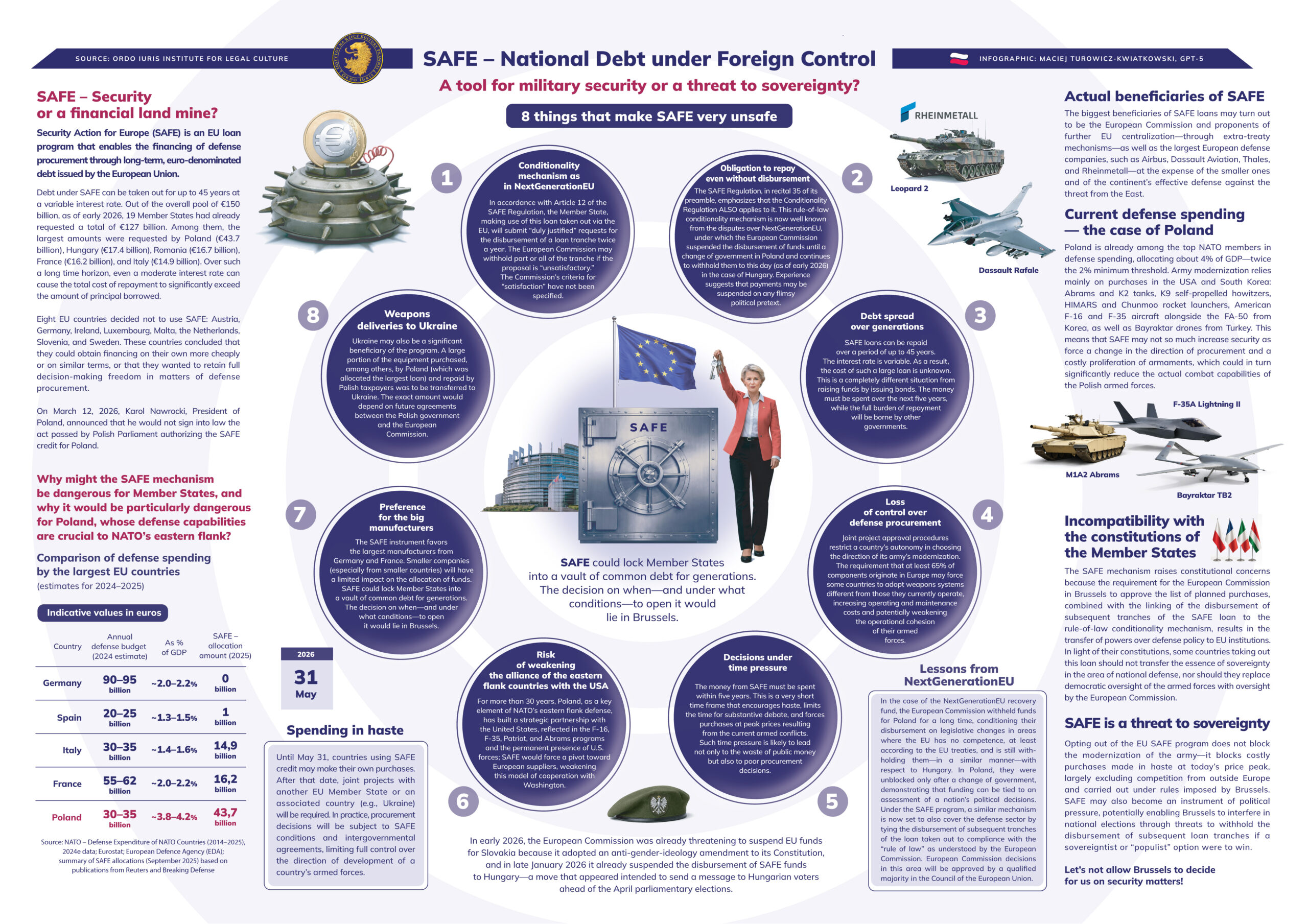
Download the infographic in jpg or pdf format.
See also:
Source of cover photo: iStock
